Project Edix
Systems work: anchoring academic certificates to a blockchain so anyone can verify them, without putting student data on a public ledger.
The problem
Primary and secondary schools face two related risks: grades can be altered directly in a school's database, and digital certificates issued to students are hard for anyone outside the school to verify as genuine.
The design
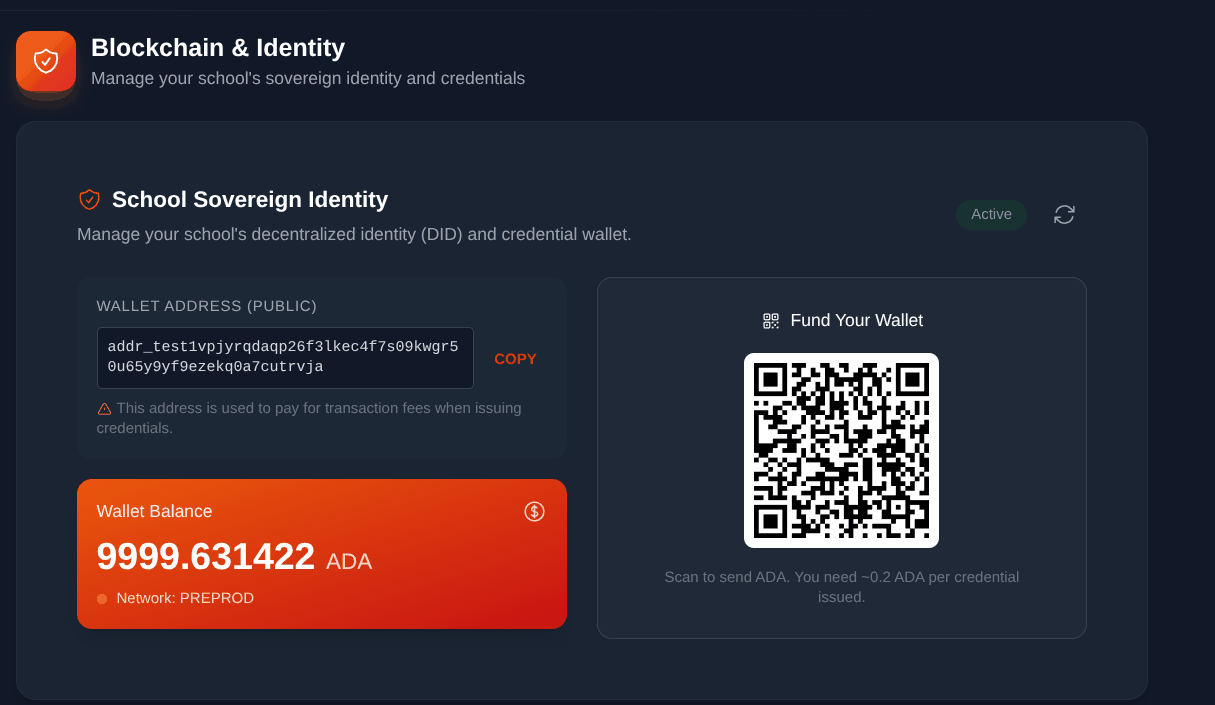
Each school gets a sovereign identity (DID) and wallet. When a certificate is issued, its hash — not its contents — is written on-chain as a single transaction. Anyone can then verify a certificate by re-hashing it and checking the result against the chain, with no student data exposed on a public ledger. Grades leave no chain footprint at all until a certificate is actually issued.
Cardano was chosen mainly on transaction cost: issuing one hash per certificate at scale needs fees low enough that the per-student cost stays negligible on mainnet, which rules out most higher-fee chains. Running on preprod first lets that cost assumption be validated before any real ADA is spent.
Current state
Edix is deployed and in real use — schools are issuing credentials through it today, not just running it as a prototype. It currently runs on Cardano's preprod network, so the fees involved are test tokens rather than real money.
Kept here for completeness: this is architecture and distributed-systems work, not machine learning. It is on the site because the design reasoning — picking a mechanism on measured cost constraints rather than novelty — is the same reasoning the ML work runs on.